How often to flush a tankless water heater in San Jose
The short answer is once a year. The longer answer depends on your water, your use and whether a softener sits upstream.
- 4 min read
- San Jose focus
- Sept 2026 updated
Perfect Tankless Plumbing, San Jose, CA
In San Jose, flushing a tankless water heater once a year is a sensible baseline because local water runs roughly 10 to 16 grains per gallon; heavy use or harder water may call for more often, and a softener upstream can stretch the interval, but the inlet filter should still be checked each year.
Why tankless units need flushing
When hard water is heated, minerals drop out as scale. In a tankless heater that happens inside the heat exchanger, a set of narrow passages where the water picks up heat from the burner. Scale insulates those passages and narrows them. The unit has to work harder, delivers less hot water, and eventually shows a scale or overheat warning.
Descaling dissolves that layer with a mild acid solution circulated through the heat exchanger, then flushes it out with clean water.
The baseline for San Jose water
Published guidance on San Jose water puts hardness at roughly 10 to 16 grains per gallon depending on the season and the blend of Sierra water and valley groundwater. San Jose Water Company treats anything above 7 as hard, and its data for valley-floor groundwater runs higher still in places.
At those levels, once a year is a reasonable starting point for most households. Large households, homes on harder groundwater, or units that run many hours a day may benefit from more frequent flushing. Most manufacturers also set a maintenance schedule in the manual, and some warranties expect it to be followed.
| Situation | Suggested interval | Notes |
|---|---|---|
| Typical household, no softener | Once a year | Check the inlet filter too |
| Large household or heavy use | Every 6 to 12 months | Watch for a scale warning |
| Salt-based softener upstream | Every 2 to 3 years or per manual | Still check the filter yearly |
| Salt-free conditioner upstream | Around yearly | Reduces scale, does not remove hardness |
| Unit showing a scale warning | Now | Do not wait for the schedule |
| Commercial or racked units | Per manufacturer, often more often | Rotate units evenly |
What the flush involves
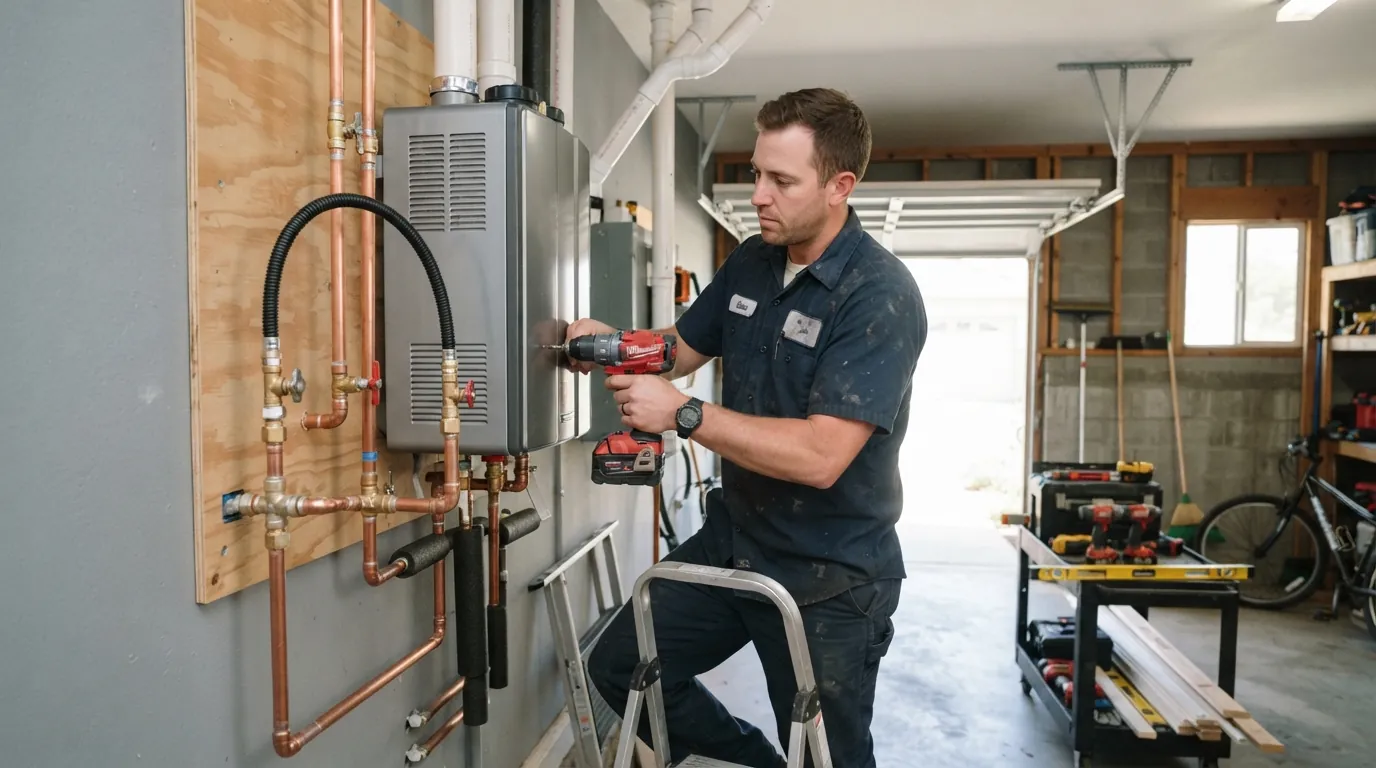
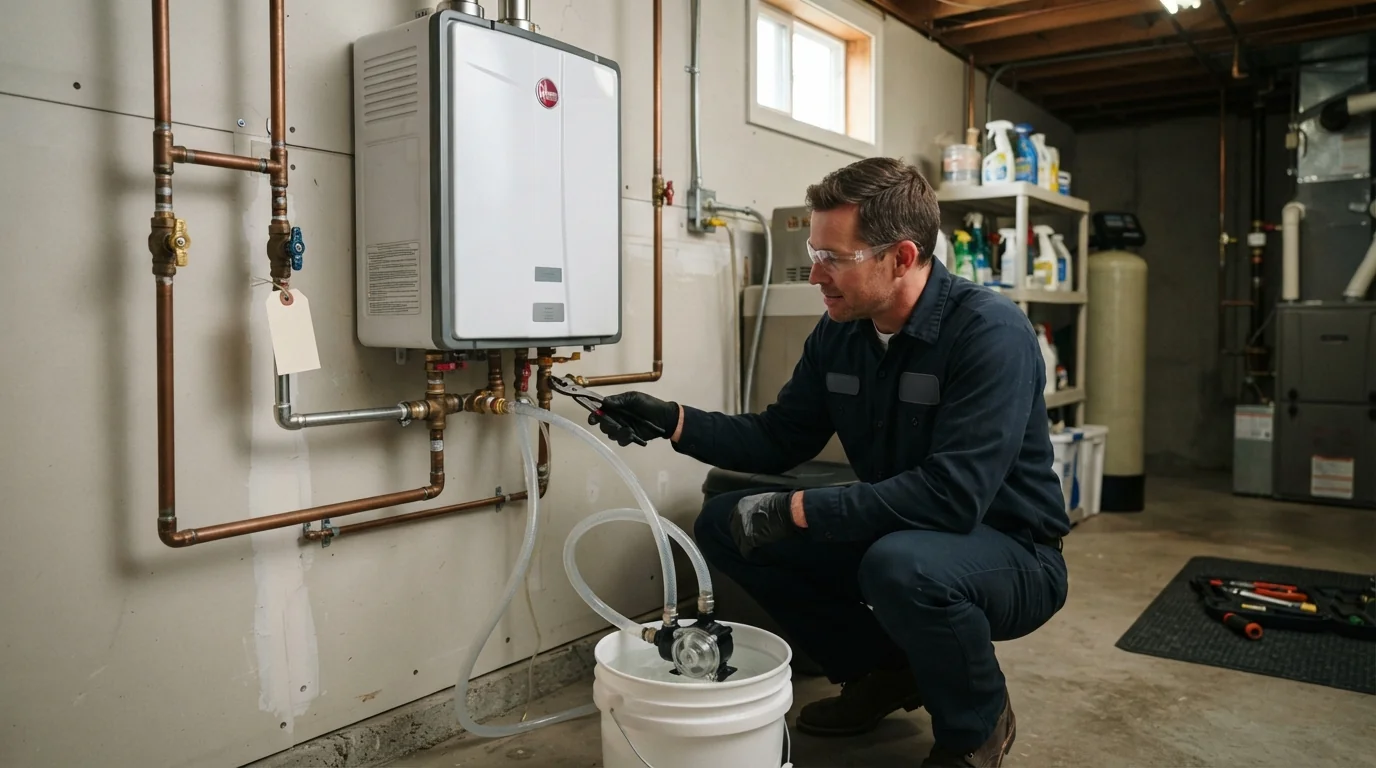
The unit is turned off and isolated using valves on the hot and cold lines. A small pump circulates the descaling solution through the heat exchanger via the service ports for about an hour. The solution is drained, fresh water is flushed through until it runs clear, the inlet filter is cleaned, and the unit is restarted and tested.
Units installed without isolation valves are hard to flush without cutting pipe. Fitting a valve kit once makes every future flush a short job.
Due for a flush? Call to book descaling and an annual check in one visit.
Call (669) 281-0871Signs a flush is overdue
The water takes longer to get hot, or never quite reaches the set temperature. Temperature swings during a shower. Flow at the tap feels weaker than it used to. The unit displays a scale or maintenance code. You hear more noise from the unit than before. Any of these, in a unit that has not been descaled in a year or more, is worth acting on.
Doing it yourself
Handy owners with isolation valves already fitted can descale using a pump, hoses and a manufacturer-approved solution, following the manual. Turn the power off first, close both valves, and never run the burner without water flowing. If the unit has no service valves, or you are not comfortable working near the gas and electrical connections, it is a short professional visit.
What a softener changes
A salt-based softener upstream of the heater removes most of the hardness before it reaches the heat exchanger, which slows scaling dramatically and can stretch the flushing interval considerably. It also protects fixtures and other appliances. A salt-free conditioner reduces scale formation but does not remove hardness, so the benefit is smaller. Either way, the inlet filter still collects grit and is worth checking every year.
From the guide to the job
Services related to this guide
Tankless Descaling and Flush
Isolation valve retrofit, Inlet filter cleaning.
Isolation valve retrofit and related workTankless Water Heater Repair
Error code diagnosis, Ignition failure.
How we handle tankless water heater repairWater Softener Installation
Salt-based softener, Salt-free conditioner.
Read about water softener installation
FAQ
Questions readers ask about this
Once a year is a sensible baseline, more often with heavy use, less often with a softener.
Scale builds on the heat exchanger, reducing hot water and eventually triggering errors or damage.
Some manufacturers allow it; others specify a descaling solution. Follow the manual.
A valve kit can be fitted so it can be flushed now and every year after.
Many warranties expect maintenance per the manual. Keep a record of each flush.
More guides
Keep reading
Why a Tankless Water Heater Goes Cold Mid-Shower
Scale, low flow, gas supply and sizing: how to tell which is making your shower go cold.
Read the guide on tankless goes coldHard Water and Your Water Heater in San Jose, CA
What the local hardness numbers mean for tanks and tankless units, and what helps.
Hard water and heaters
One number, any hour
Book your tankless flush
Call to schedule descaling, a filter clean and a full annual check.