Water softeners sized for San Jose's hard water
San Jose water is hard enough to shorten the life of a water heater and cake every aerator in the house.
- 24/7 answered
- Phelan Ave San Jose office
- Tank, tankless, heat pump
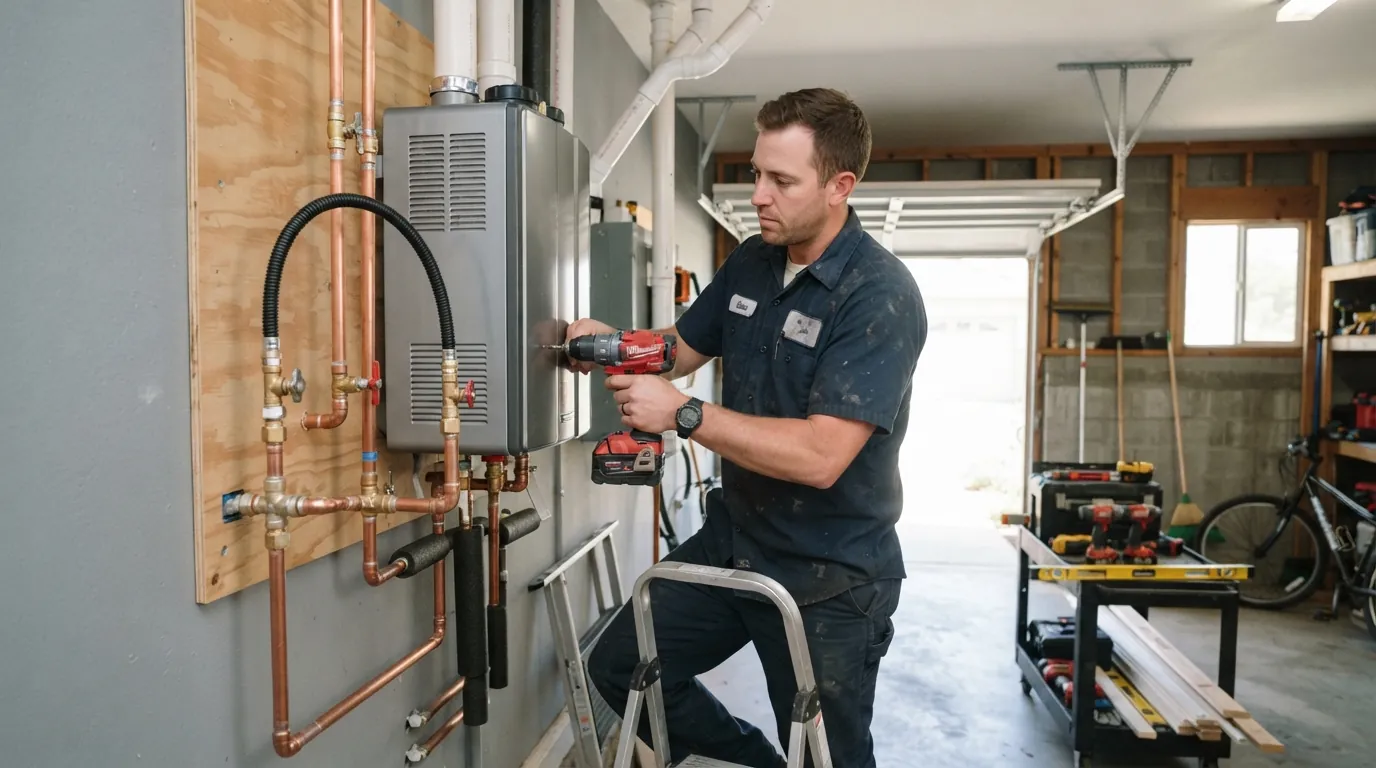
Perfect Tankless Plumbing, San Jose, CA
A water softener in San Jose treats water that San Jose Water Company data puts at roughly 11 to 26 grains per gallon on the valley floor; we size the unit to your measured hardness and household use, install it at the main line with a bypass valve, and set the regeneration schedule before we leave.
Updated September 2026
Repipe, Gas & Water Quality
What a softener actually does to San Jose water
Hard water carries dissolved calcium and magnesium, and heat drives them out of solution. That is why the problem shows up first in the water heater, as sediment in a tank or scale inside a tankless heat exchanger, and then on showerheads, glass doors and faucet aerators.
A salt-based softener swaps those minerals for sodium or potassium through ion exchange, so the water that reaches the heater no longer leaves scale. A salt-free conditioner changes how the minerals behave rather than removing them; it reduces scale formation but will not give you the feel of softened water. Which one fits depends on your hardness, your drain access, and what you want to protect.
Cost factors
What changes the price of a softener install
Installed cost depends more on the plumbing around the unit than on the unit, and we have no local range worth publishing.
- Type of system. salt-based softeners need a drain and outlet; salt-free tanks need neither
- Resin capacity. higher hardness and bigger households need a larger unit
- Distance to the main line. a softener beside the main is quicker than one that needs a new loop
- Drain access. the brine drain needs an air gap and a legal discharge point
- Bypass and hard-water bib. keeping a hard line for irrigation adds a little piping
- Added filtration. pairing a catalytic carbon filter for chloramine adds a second vessel
Options
Softener or conditioner for your house
Both protect plumbing. Only one removes hardness.
| Salt-based softener | Salt-free conditioner | |
|---|---|---|
| Removes hardness | Yes | No, it changes how minerals behave |
| Needs a drain | Yes, for regeneration | No |
| Needs salt | Yes, topped up regularly | No |
| Feel of the water | Slick, softened | Unchanged |
| Spots on glass | Largely gone | Still visible |
| Best for | Maximum scale protection and softer water | Scale reduction where drains or salt are a problem |
Included
What a softener install includes
- Hardness test at your tap
- Sizing based on hardness and household use
- Installation at the main line
- Bypass valve for servicing
- Brine drain with an air gap where needed
- Control head programmed for your water
- Softened water tested at a fixture
Salt-based softener
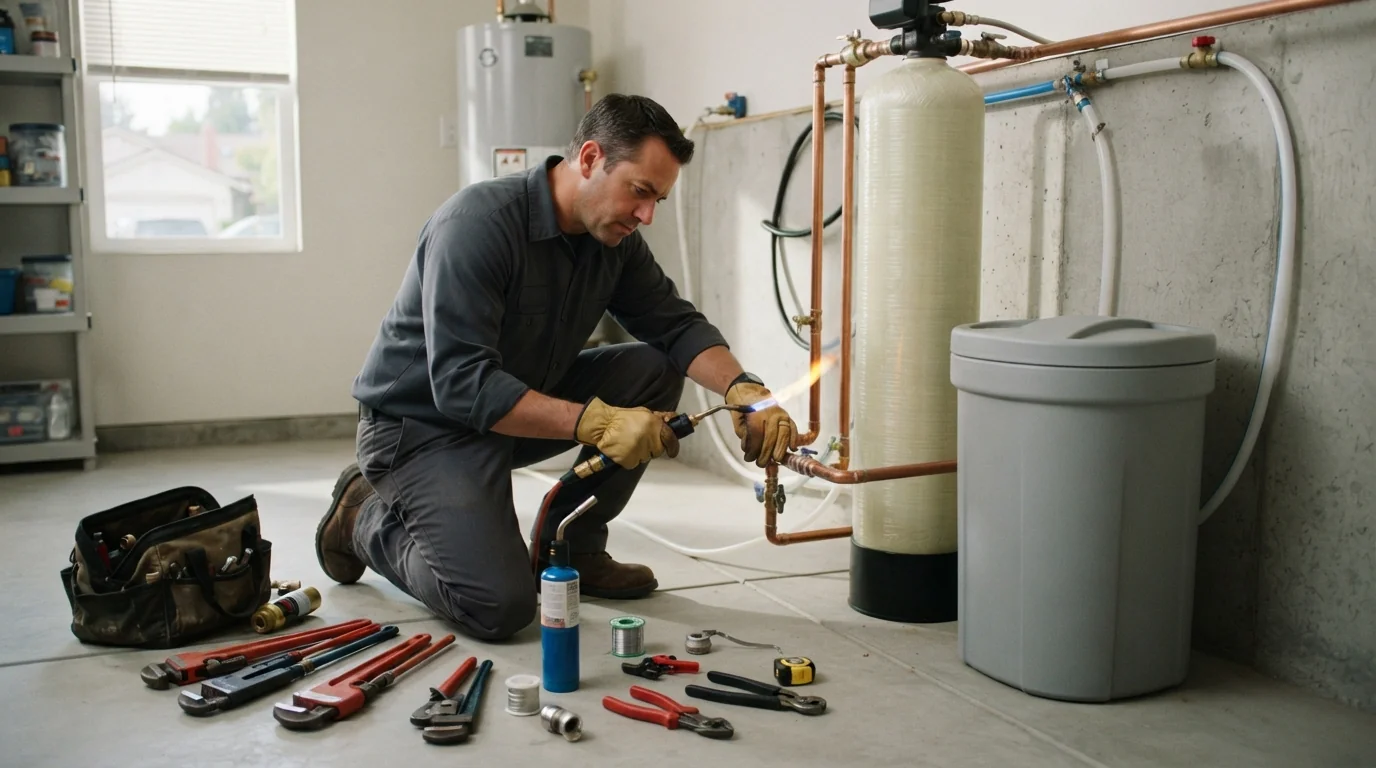
A salt-based softener is the only option that actually removes hardness. It needs a spot near the main line, a drain for the regeneration water, and an outlet for the control head. We install it with a three-valve or manufacturer bypass so you can service it without cutting water to the house, run the brine drain with a proper air gap, and leave a hose bib on the hard side if you want untreated water for the garden.
Salt-free conditioner
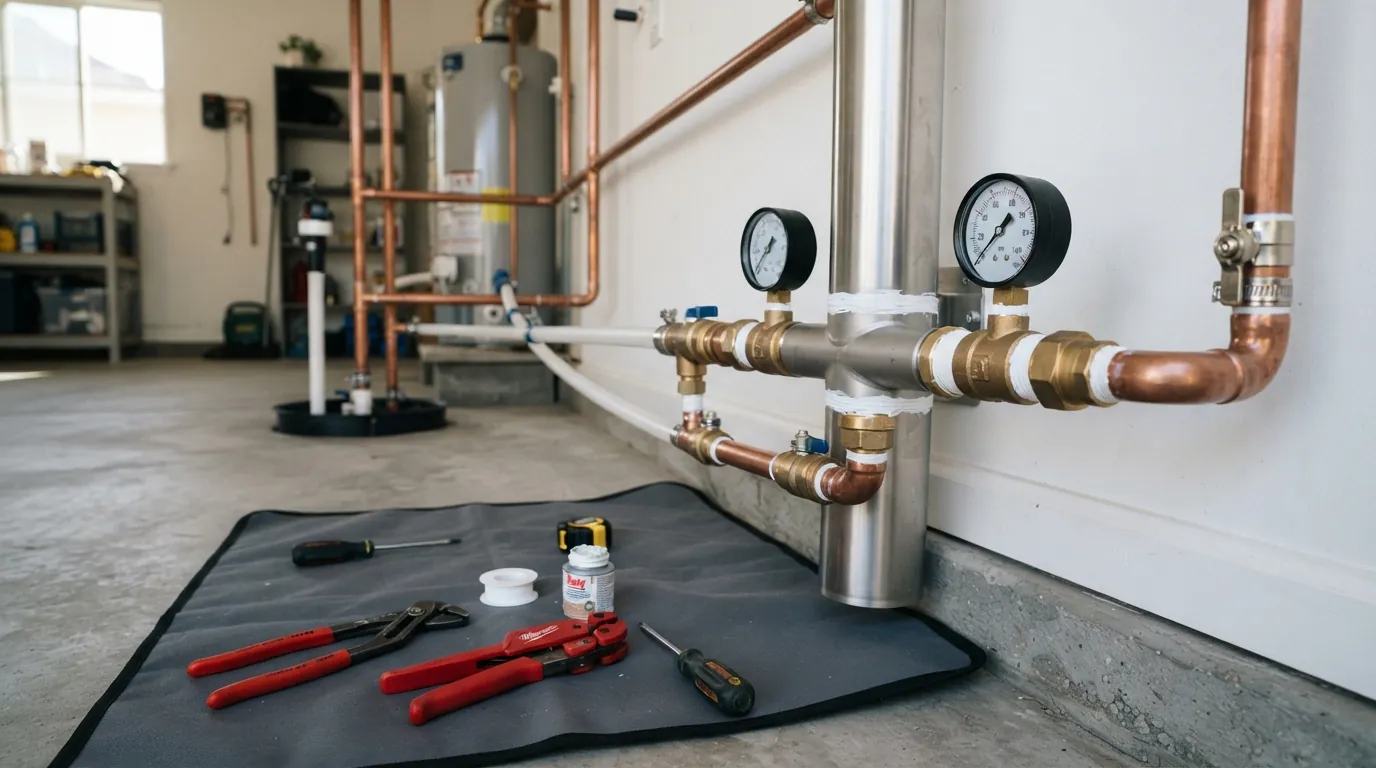
A salt-free conditioner, usually a template-assisted crystallization tank, turns dissolved hardness into tiny crystals that are far less likely to stick to hot surfaces. It needs no drain, no salt and no electricity, which makes it easy to place in a garage or side yard. It does not soften the water, so you will still see spots on glass and it will not give the slick feel of softened water. We recommend it when drain access is difficult, when someone in the house is on a sodium-restricted diet, or when the main goal is protecting a water heater.
Sizing for hardness and household
Sizing starts with a hardness test at your tap, because San Jose water varies with the blend of groundwater and imported supply that reaches your street. We multiply that hardness by daily use for the household to get the grains the unit must remove each day, then pick a resin capacity that regenerates every few days instead of every night. An undersized softener wastes salt and water; an oversized one can let the resin sit too long. We also check your pressure and pipe size so the unit does not choke flow to the upstairs shower.
Local context
Why hardness varies from one San Jose street to the next
San Jose Water Company reports that groundwater serving most of the Santa Clara Valley floor tests roughly 11 to 26 grains per gallon, while imported surface water reaching parts of the system runs closer to 4.5 to 9. Anything over 7 counts as hard. The city also disinfects with chloramine, so if you want a filter alongside the softener it needs catalytic carbon rather than standard carbon. That is why we test at your tap before recommending a unit instead of assuming one number for the whole city.
How the job runs
How a softener install runs
- 1
Test the water
We measure hardness at a tap and check pressure and pipe size.
- 2
Choose and size
Salt-based or salt-free, and a capacity matched to your household.
- 3
Plan the loop
We find the main line, a drain and an outlet, and agree where the unit sits.
- 4
Install with a bypass
The unit goes in with a bypass so it can be serviced without shutting off the house.
- 5
Program and test
We set hardness and regeneration, then test softened water at a fixture.
- 6
Show you the upkeep
Where the salt goes, how to bypass, and what to watch for.
FAQ
Water Softener Installation questions from San Jose homeowners
San Jose Water Company data puts groundwater on most of the valley floor at roughly 11 to 26 grains per gallon, with imported surface water in parts of the system lower.
Yes. Scale on the heat exchanger is the most common cause of reduced flow and error codes on tankless units.
Yes. We can leave a hose bib or irrigation line on the hard side.
They reduce scale on hot surfaces but don't remove hardness, so you'll still see spots on glass.
A softener doesn't remove chloramine. For that we pair it with a catalytic carbon filter.
Same family
Related work in repipe, gas & water quality
Whole-House Repiping
PEX repipe, Copper repipe.
How we handle whole-house repipingWater Pressure Booster Pump Installation
Upstairs and hillside pressure, Constant-pressure pump sizing.
Water Pressure Booster Pump Installation in San JoseGas Line Installation and Repair
Gas leak repair, New appliance stub.
How we handle gas line installation and repairWater Filtration Systems
Whole-house carbon, Reverse osmosis at the sink.
Read about water filtration systemsPlumbing Inspection
Pre-purchase inspection, Annual whole-home check.
How we handle plumbing inspection
From our guides: Read the guide on hard water and heaters, How often to flush tankless, explained, Softener or conditioner, Navien error codes, explained.
One number, any hour
Get a softener sized for your water
Call and we will test your hardness, talk through softener versus conditioner, and book the install.