Rinnai error codes explained for San Jose homeowners
A Rinnai showing a code is telling you which system tripped. Here is what the common codes mean and which ones you can safely check yourself.
- 4 min read
- San Jose focus
- Sept 2026 updated
Perfect Tankless Plumbing, San Jose, CA
The most common Rinnai tankless codes are 10 for an air supply or exhaust blockage, 11 for no ignition, 12 for flame failure, 14 and 16 for overheating, 79 for water leaking inside the unit and LC for scale in the heat exchanger; gas, power and vent checks are safe for owners, while anything inside the cabinet is a job for a plumber.
How Rinnai codes work
Rinnai tankless heaters monitor ignition, flame, temperature, airflow and water flow as they run. When something falls outside its safe range, the unit stops heating and shows a code on the display or remote controller. Most codes are two-digit numbers; a few, like LC, use letters.
A code tells you what the unit detected, not always why. Code 11, for example, means the burner did not light. That could be a closed gas valve, low gas pressure, a dirty flame rod or a failed igniter. Reading the code is the start of the diagnosis, not the end of it.
Ignition and flame codes: 11 and 12
Code 11 means no ignition: the unit tried to light the burner and never detected a flame. It is one of the most common Rinnai codes. Before calling, check that the gas valve to the heater is open and that other gas appliances, like the range, are working. If the gas was recently shut off, the line may need to be purged.
Code 12 means flame failure: the burner lit and then lost its flame. Causes include gas pressure that drops when other appliances run, a dirty or loose flame rod, and venting problems. Both codes often trace back to loose or dirty flame rods or electrodes, which a plumber can clean or replace without bigger parts.
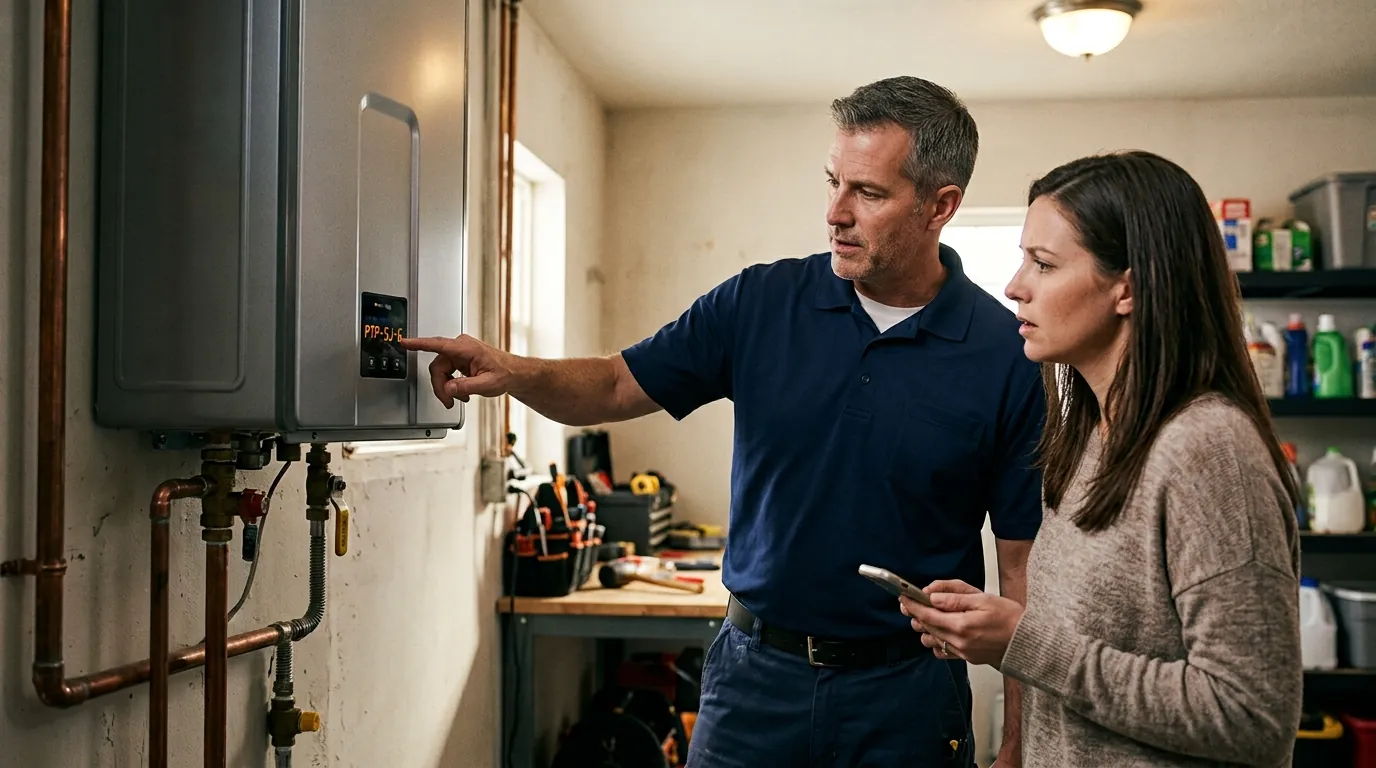
Air and exhaust: code 10
Code 10 means the unit cannot draw combustion air or vent exhaust properly. Look at the vent terminal outside for nests, leaves or anything blocking it, and make sure nothing is stacked against an indoor unit's air intake. On condensing models, a blocked condensate drain can also back up and trigger the code.
If code 10 comes straight back after the vent is clear, the cause is usually inside the vent run, a sizing problem or the combustion fan, and it needs a plumber.
Rinnai showing a code that keeps coming back? Call and read it to us, and we will bring the right parts.
Call (669) 281-0871Overheating: codes 14 and 16
Code 14 relates to the thermal fuse or overheat protection, and code 16 is an over-temperature warning. Both mean the unit got hotter than it should. In hard-water areas, the most common cause is scale coating the heat exchanger, which stops heat moving into the water.
Low water flow, a clogged inlet filter and restricted airflow can also cause overheating. These codes are safety codes, so if they return after a reset, stop using the unit and call.
Leaks and scale: 79 and LC
Code 79 means the unit has detected water inside its cabinet. Turn off the water and gas to the heater, switch off the power and call. Do not keep resetting it, because the leak may be at a fitting, a valve or the heat exchanger itself.
LC codes mean scale is building up in the heat exchanger and the unit needs a descaling flush. You can often clear the code temporarily, but the scale is still there. In the harder parts of the valley, LC codes come up often, which is why a yearly flush is worth scheduling.
What you can check, and what to leave
Safe owner checks: the gas valve is open, the power and breaker are on, the vent terminal is clear and the inlet water filter is clean if your model makes it accessible. Anything inside the cabinet, including flame rods, igniters, sensors, gas valves and the control board, should be left to a plumber.
If a code returns after one reset, call rather than resetting repeatedly. Repeated resets can hide a real problem and, with overheat or leak codes, make it worse.
From the guide to the job
Services related to this guide
Rinnai Tankless Water Heater Repair
Ignition and flame codes, Scale and overheat codes.
Read about rinnai tankless water heater repairTankless Descaling and Flush
Isolation valve retrofit, Inlet filter cleaning.
Tankless Descaling and FlushTankless Water Heater Repair
Error code diagnosis, Ignition failure.
Error code diagnosis and related work
FAQ
Questions readers ask about this
Code 11, no ignition, along with LC scale codes in hard-water areas.
Once, after checking gas, power and venting. If it returns, call a plumber.
Usually not. Most codes point to a repairable cause.
Flush the unit regularly and consider a softener if scale keeps returning.
No. Turn off the water, gas and power and call, because water is leaking inside the unit.
More guides
Keep reading
Why a Tankless Water Heater Goes Cold Mid-Shower
Scale, low flow, gas supply and sizing: how to tell which is making your shower go cold.
Our tankless goes cold guideHow Often to Flush a Tankless Water Heater in San Jose
Descaling intervals for local water, what the flush involves and the signs it is overdue.
How often to flush tankless, explained
One number, any hour
Code still showing?
Call and read us the code. We will tell you what it likely means and bring the right parts.